


 WhatsApp Business +91 88000 09776
 CSC
CSC  WhatsApp Business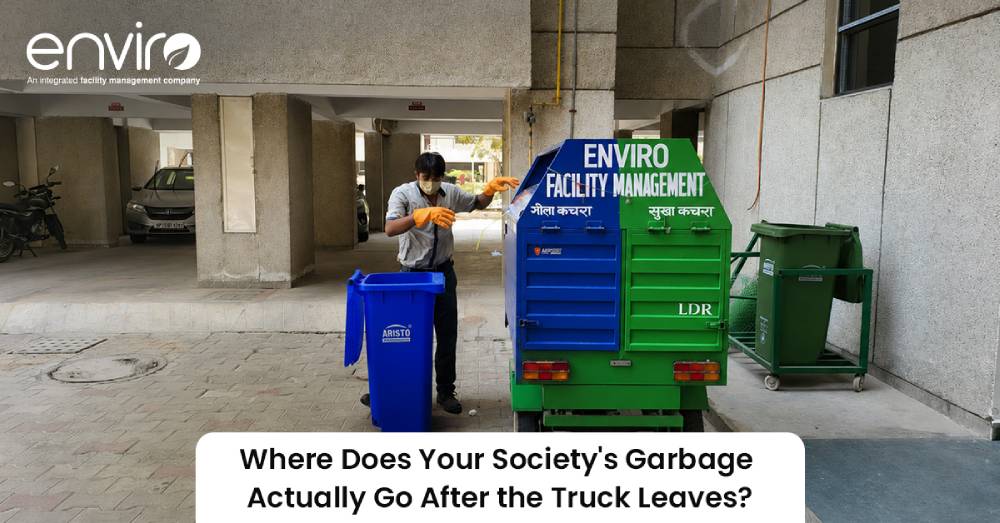
Every morning, a garbage truck enters our society, collects the waste and drives away.
The bins are empty. The surroundings look clean. Life goes on as usual.
But have you ever stopped to think about what happens after that?
Does all the waste get recycled? Does the food waste become compost? Or does most of it simply end up in a landfill?
The truth is, the journey of our garbage doesn’t end when the truck leaves the society . In fact, that’s where one of the biggest challenges in waste management begins.
As Indian cities continue to grow, so does the amount of waste we generate. Our country produces a massive quantity of municipal solid waste every day. Municipal corporations across India are working to strengthen collection systems, improve recycling infrastructure and encourage segregation at source. But there is one problem that even the best waste management infrastructure cannot easily solve.
Mixed waste.
When wet and dry waste are thrown into the same bin, recovering recyclable material becomes far more difficult. Food waste contaminates paper and cardboard. Plastic packaging gets mixed with organic waste. Material that could have been recycled or composted may eventually become unusable. That is why effective waste management does not begin at a landfill or at a processing plant.
It begins from our home.
The Numbers Tell an Important Story
An average person can generate several hundred grams of waste every day. Now imagine a residential society with 500 residents.
Even if each resident generates around 500–700 grams of waste daily, the society could collectively produce approximately:
. 250–350 kg of waste every day
. 8–10 tonnes of waste every month
. Nearly 100 tonnes or more every year
That is just one residential community.
Now multiply this by the thousands of housing societies across our cities. The numbers become enormous. But perhaps the more important question is not simply:
How much waste are we generating?
It is:
How much of that waste could have been reused, recycled or composted—but wasn’t because it was not managed properly?
The Journey of Our Garbage
Once the garbage truck leaves your society, the waste doesn’t simply disappear. Where it goes next depends greatly on how it was handled before collection. If waste has been properly segregated, different types of material can follow different paths:
Wet waste
Kitchen and biodegradable waste can be composted or, depending on the available infrastructure, processed to produce biogas.
Dry waste
Paper, cardboard, certain plastics, metals and glass can be sorted and sent for recycling.
Sanitary and domestic hazardous waste
This requires separate handling and appropriate disposal.
The problem begins when everything is thrown together. Once wet food waste, plastic, paper, glass and sanitary waste are mixed, recovering useful materials becomes more difficult, unpleasant and expensive. Recyclable materials may become contaminated, while biodegradable waste becomes harder to process effectively. A large quantity of potentially useful material can then end up as nothing more than garbage.
Why Segregation at Source Matters
One of the biggest reasons recyclable materials end up in landfills is poor segregation at the source. And “source” simply means where the waste is first generated—our homes. Source segregation means separating different types of waste before they leave the household. It sounds like a very small action, But that one action can influence the entire journey of waste after collection.
At the most basic level, residents can separate:
Wet or biodegradable waste
This includes:
. Leftover food
. Fruit and vegetable peels
. Tea leaves
. Flowers
. Garden waste
Much of this material can be composted or processed as biodegradable waste.
Dry waste
This may include:
. Paper
. Cardboard
. Plastic
. Metal
. Glass
. Clean packaging material
Keeping recyclable materials clean and separate makes their recovery far easier.
A significant portion of household waste is biodegradable, while another substantial share consists of potentially recyclable materials. If these are separated before collection, they have a much better chance of being put to productive use.
But once everything is mixed together, recovering those resources becomes much harder.
The right waste in the right bin may seem like a small habit. But multiplied across hundreds of homes, it can make a huge difference.
The Often-Overlooked Role of Housekeeping Staff and Domestic Helpers
Waste management is not only the responsibility of residents. Think about what happens after you hand over your garbage.
The waste may pass through the hands of domestic helpers, housekeeping teams, door-to-door collection staff and waste handlers before it leaves the society. If waste is carefully segregated inside the home but gets mixed during collection, the entire effort is lost.
This is why training is so important.
Housekeeping staff, domestic helpers and collection teams should understand how to:
. Keep wet and dry waste separate during collection
. Prevent recyclable materials from becoming contaminated
. Identify different waste categories
. Follow the society’s disposal process consistently
A society can install the best bins and put up the best posters, but if the people handling waste every day are not part of the system, segregation will eventually fail.
Waste management works only when the entire chain works.
A considerable amount of the waste generated in residential communities is biodegradable. Instead of transporting all of it outside the premises, societies can explore suitable on-site composting solutions.
The compost produced can then be used for:
. Society gardens
. Landscaping
. Tree plantation
. Green areas within the community
This can reduce the quantity of waste leaving the society while creating something useful from material that would otherwise be discarded.
There is something quite satisfying about the idea that:
Yesterday’s kitchen waste could help grow tomorrow’s garden.
Why Every Resident Has a Role to Play
It is easy to think of waste management as someone else’s job.
The municipality will handle it.
The housekeeping team will collect it.
The waste truck will take it away.
But every bag of garbage begins somewhere.
It begins with us.
Every resident contributes to the waste generated by a community. And every resident can also contribute to managing it better.
Small habits matter:
. Segregating waste before disposal
. Reducing unnecessary single-use plastic
. Keeping recyclable materials clean and dry
. Disposing of sanitary and hazardous waste responsibly
. Supporting the society’s waste-management initiatives
One household doing this may seem insignificant.
Five hundred households doing it every day is not.
So, Where Does Your Garbage Actually Go?
The garbage truck may leave your society within a few minutes.
But your waste continues its journey long after it disappears through the gate.
Some of it may be recycled.
Some may become compost.
Some may be processed.
And unfortunately, some may still end up in a landfill.
The real question, therefore, is not just:
“Where does the garbage truck go?”
It is:
“Where does my garbage finally end up—and could I have helped change its destination?”
Waste has the potential to become a resource when it is managed correctly. By segregating waste at source, supporting recycling, training the people who handle waste and exploring composting, residential communities can reduce the amount of material that reaches landfills.
Because a cleaner society is not created simply by collecting more garbage.
It is created by managing what we throw away more responsibly.
