


 WhatsApp Business +91 88000 09776
 CSC
CSC  WhatsApp Business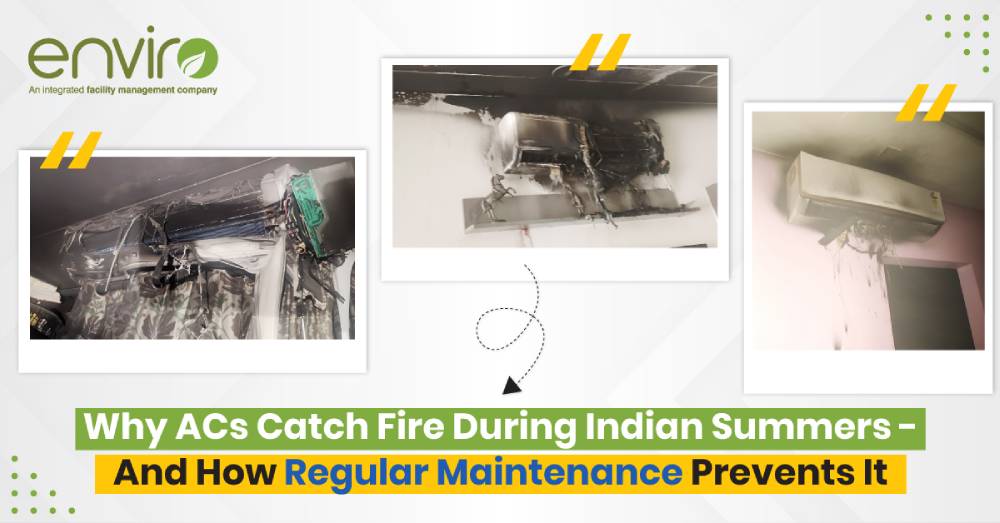
Every summer, the same headlines start appearing across Indian cities — air conditioners bursting into flames, smoke pouring out of flats, families rushing out of buildings in panic.
One such incident happened recently in a residential society in Noida, where an AC unit caught fire inside an apartment. Thankfully, the building’s sprinkler system controlled the damage before it spread further. But many societies are not prepared for that kind of emergency.
In many North Indian cities, residential cooling demand has increased sharply as summer temperatures and occupancy loads continue to rise. In cities where temperatures touch 44°C or more, ACs often run for 16–20 hours a day. Older wiring, overloaded circuits, poor installations, and lack of servicing turn that constant usage into a serious fire risk.
For RWAs, AC reliability now directly impacts both resident safety and building risk management.
Why AC Units Become Dangerous During Peak Summer:
1. ACs Pull Heavy Power at Start-Up
Every time an air conditioner starts, it draws a sudden spike of electricity — much higher than its normal running load.
In older apartments, the electrical system was never designed for today’s lifestyle, where a single home may run:
. Multiple ACs
. Refrigerators
. Washing machines
. Geysers
. Microwaves
. Induction cooktops
When all of these appliances operate together, the wiring and electrical panels come under enormous pressure.
Over time, overheated wires, loose connections, and overloaded circuits become potential fire points.
2. Inverter ACs Can Create Hidden Electrical Stress
Modern inverter ACs save electricity, but they also affect power quality differently from older systems. Instead of drawing smooth electrical current, they consume power in pulses. In large residential buildings, this can create what engineers call “harmonic distortion” — extra electrical stress inside the system.
The biggest problem? The neutral wire can slowly overheat without anyone noticing.
Since most breakers only protect the phase wire, the overheating may continue silently inside walls for weeks or months before a short circuit or fire occurs.
This is one of the most ignored electrical risks in older high-rise societies.
3. Dirty Filters Force the AC to Overwork
A clogged AC filter looks harmless, but it makes the entire system work harder.
When airflow reduces:
. The compressor heats up faster
. Power consumption increases
. Cooling efficiency drops
. Electrical load rises
In dusty cities like Delhi-NCR, Jaipur, Ahmedabad, and Gurgaon, filters can get blocked surprisingly fast — sometimes within a few weeks during peak summer.
Outdoor condenser units face similar issues. Dust, leaves, and debris reduce heat dissipation, causing overheating.
4. Faulty Capacitors and Circuit Boards
Two common AC failure points during summer are:
. Capacitors
. PCBs (Printed Circuit Boards)
When voltage fluctuates continuously or the AC runs for long hours without rest, these components can fail.
A damaged capacitor may spark or arc. A faulty PCB can short-circuit and ignite nearby plastic or insulation material.
This is especially common in ACs that haven’t been serviced regularly.
5. Poor Installation is Still a Huge Problem
Many residential societies still have AC units installed years ago using:
. Undersized wiring
. Shared circuits
. Low-quality cables
. Incorrect MCB ratings
Back then, buildings were not designed for today’s electrical load.
What worked in 2008 may not be safe in 2026.
Improper installations remain one of the biggest causes of overheating and repeated breaker trips in apartments.
What a Professional Facility Management Team Does Differently?
Most people call for AC servicing only after a problem happens.
A professional FM company works the other way around — preventing failures before summer begins.
Planned Preventive Maintenance
Instead of reactive servicing, structured AMC schedules include:
. Filter cleaning
. Coil inspection
. Gas pressure checks
. Electrical tightening
. Capacitor testing
. Drain line inspection
At Enviro, preventive AC servicing is typically scheduled before peak summer starts, followed by another round during the high-load season.
This helps identify weak components before they fail.
Electrical Audits Before Summer
A proper electrical audit can reveal hidden risks that residents usually never notice.
FM technical teams inspect:
. Distribution boards
. MCB ratings
. Cable heating
. Neutral load imbalance
. Earthing condition
. Loose electrical joints
In many cases, simple load redistribution prevents major breakdowns later.
Real-Time Monitoring Through Smart Systems
Modern facility management is no longer dependent only on manual inspections.
Advanced FM systems now use IoT-enabled monitoring to track:
. Voltage fluctuations
. Temperature rise inside panels
. Power quality issues
. Abnormal electrical behaviour
This allows technical teams to respond before a fault becomes dangerous.
Resident Awareness Matters Too
Even the best infrastructure can become unsafe if residents ignore warning signs.
Simple habits make a big difference:
. Avoid running ACs through extension boards
. Don’t ignore repeated breaker trips
. Service ACs before summer
. Keep outdoor units ventilated
. Report burning smells immediately
A proactive FM team regularly shares seasonal safety advisories with residents instead of waiting for complaints.
A Practical Summer AC Safety Checklist for RWAs
Before peak summer arrives, every residential society should ideally:
. Service all common-area ACs
. Inspect electrical panels and DBs
. Test fire extinguishers and sprinkler systems
. Check emergency response systems
. Ensure outdoor units have proper ventilation
. Conduct an electrical safety audit
. Share AC safety guidelines with residents
These small preventive steps can avoid major emergencies later.
Why Preventive Maintenance Saves More Than Money?
Many RWAs still see maintenance as an expense.
In reality, preventive maintenance reduces:
. Fire risk
. Equipment breakdowns
. Emergency repair costs
. Resident complaints
. Downtime during summer
More importantly, it protects lives.
When technical systems are ignored year after year, failures become unavoidable. The difference between a minor issue and a major fire often comes down to one thing — whether somebody checked the system in time.
Frequently Asked Questions
How often should ACs in residential societies be serviced?
At least twice a year is recommended:
. Before summer begins
. Once during peak summer
Common-area ACs in clubhouses, gyms, and lobbies may require more frequent servicing.
Are electrical audits necessary for housing societies?
Absolutely. Many electrical systems in older buildings are carrying much higher loads than originally planned.
Annual audits help identify overheating, poor wiring, overloaded circuits, and ageing infrastructure before they become dangerous.
Can facility management companies coordinate with AC brands under warranty?
Yes. A professional FM company can coordinate with OEM service teams, track maintenance records, and ensure warranty conditions are maintained properly.
What MCB is normally used for a 1.5-ton AC?
Typically, a dedicated 16A MCB is recommended for a 1.5-ton split AC. However, the correct setup depends on the wiring condition, cable size, and total electrical load of the apartment.
A qualified electrician or FM technical team should always verify this during installation.
Final Thought
Most AC fires do not happen suddenly. The warning signs usually exist for weeks or months:
. Frequent tripping
. Burning smells
. Voltage fluctuations
. Overheating wires
. Poor cooling performance
The problem is that these signs are often ignored until something goes wrong.
In modern residential societies, preventive maintenance is no longer optional. It is part of basic building safety.
